The Quiet Workhorse: Why Handwoven Ceylon Cotton Belongs in Every American Closet
Photo: Unknown, No restrictions, via Wikimedia Commons
Every closet has a hero piece and a workhorse. The hero gets photographed; the workhorse gets worn on a Tuesday when you're running late. My argument here is simple and, I think, hard to refute: a handwoven Ceylon cotton shirt is one of the most useful things an American wardrobe can hold, and it is almost certainly not in yours yet.
The Case in One Paragraph
A good handloom cotton shirt breathes better than poplin, has more texture than linen without the crush, layers across at least three seasons, and reads as quietly interesting next to denim, wool trousers, and chinos alike. It costs more than a mall oxford and less than a designer blazer, and unlike either, it gets better with washing. The catch is that "handwoven" is now a marketing term as often as it is a fact, which is why the sourcing section below matters as much as the styling ones.
Breathability Isn't a Marketing Word
Handloom cotton is woven on a pit or frame loom at a lower density than industrial broadcloth. That looser weave leaves microscopic gaps between yarns, and air moves through them. In a Washington or Atlanta August, this is the difference between a shirt you tolerate and a shirt you forget you're wearing. In dry Western heat it matters less for sweat and more for cling — the fabric stays off the skin instead of pasting to it.
It's also worth saying plainly: this is not performance fabric. It won't wick in the technical sense. It just doesn't need to.
Texture Is Doing the Work
You can spot handloom from across a room. Slight slubs in the yarn, a faint irregularity in the weave, a selvedge that looks made by a person. Photographs flatten this, which is why the fabric often underwhelms online and then surprises you in the hand. Against flat, uniform cotton — most of what's in a standard American closet — the difference is immediate. It makes a plain outfit look considered.
Layer It in at Least Three Seasons
Summer is obvious: worn alone, sleeves rolled, untucked. Fall is where it earns its keep. A handloom shirt under a crewneck sweater, collar out, is a better version of a look everyone already owns. Winter, it functions as a mid-layer beneath a wool overshirt or a heavy cardigan, adding warmth without bulk. Spring, it goes back to being an overshirt over a tank. Four seasons, one garment, which is a rare thing to be able to say honestly.
What "Handwoven" Actually Means
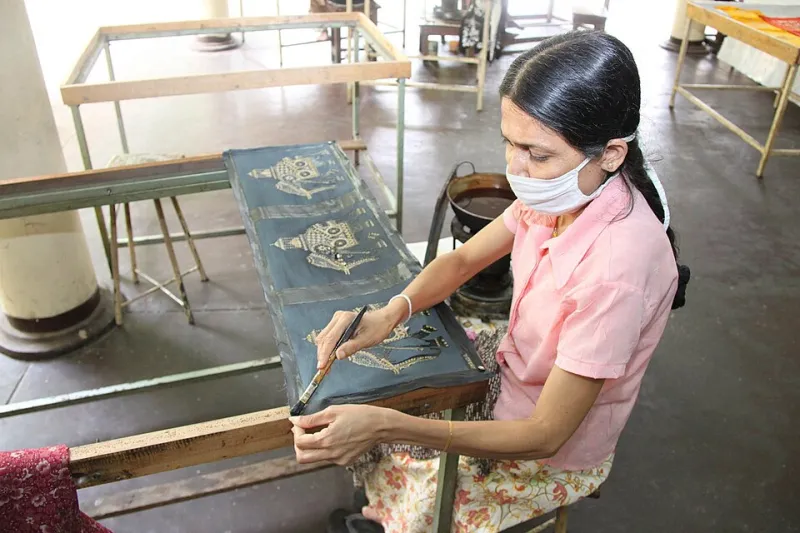
Two people can weave the same yarn and produce very different cloth. Pit-loom weaving is slower and produces narrower fabric — often 36 to 45 inches — which is why genuine handloom shirts sometimes have a seam down the center back or visible panel joins. That seam isn't a flaw. It's a receipt. Shirt-weight handloom usually lands between 100 and 140 GSM; much lighter and it turns sheer, much heavier and you've bought a jacket.
Expect the fabric to soften noticeably after three or four washes. If a shirt feels broken-in straight out of the bag, ask why.
A Sourcing Guide That Filters Out Greenwash
- Look for a named weaver or cooperative. "Artisan-inspired" means nothing. "Woven by a weaver named [X] in [town]" means something.
- Check for loom width or panel seams. Listings that mention them are usually honest about how the cloth was made.
- Know the price floor. A genuinely handwoven, cut-and-sew shirt realistically runs $85 to $190. Under $60 is almost always mill fabric with a slub print.
- Read certifications correctly. Organic certifications cover fiber and processing, not weaving. Fair-trade membership is a decent signal for labor, not for cloth.
- Insist on close-ups. Selvedge, weave texture, and a hem shot tell you more than a flat lay.
- Watch for the phrase "handloom-style." That's a machine weave mimicking the look.
- Ask three questions. Who wove it, where, and how many people were involved. Brands with real supply chains answer in a sentence.
- Be skeptical of vague language. "Sustainable" and "eco-conscious" without specifics are decoration.
Three Formulas
Office
Tucked into a mid-rise wool trouser, sleeves rolled once, no tie. Brown leather loafer, minimal belt. The texture keeps it from reading stiff, and the collar holds shape without a jacket.
Weekend
Worn open over a white tee, sleeves pushed to the elbow, with straight-leg denim and a canvas sneaker. If it's cooler, swap the tee for a fine-gauge crewneck and leave the shirt unbuttoned.
Travel
Overshirt on the plane, over a tank or tee, with a relaxed trouser and slip-on shoes. It wrinkles — accept that — and it dries fast enough to rinse in a hotel sink and wear the next morning.
Care and the Long Game
Cold wash, hang dry, iron while slightly damp. Skip bleach and skip the dryer if you can. Small snags can be darned rather than binned, and a shirt that's been mended twice looks better than one that's brand new. That's the whole appeal, really: a garment that visibly accumulates a life instead of quietly expiring.
The Bottom Line
Buy one. Wear it for a month before deciding whether you need a second. My guess is you will — and that it will spend more time on your back than the pieces you paid twice as much for.