Brushwork You Can Wear: Inside Sri Lanka's Hand-Painted Silk and Cotton Studios
Photo: Unknown authorUnknown author, Public domain, via Wikimedia Commons
The studio smell
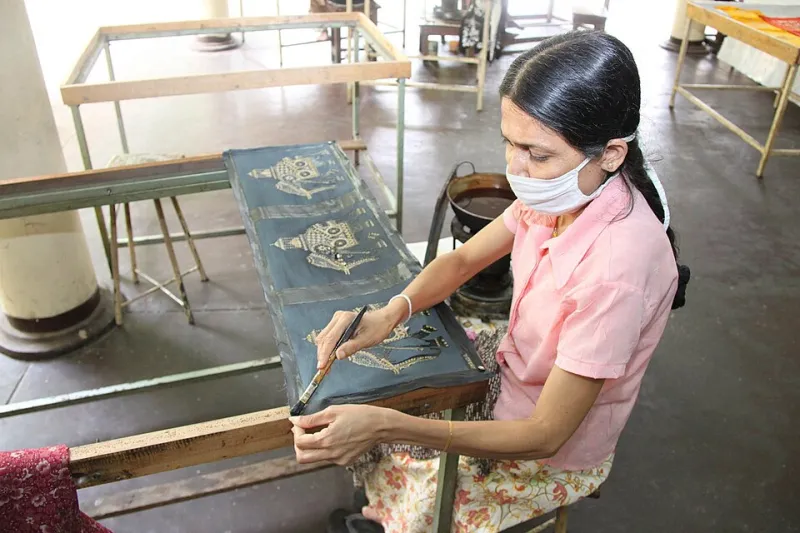
A hand-painted silk studio smells like vinegar, dye, and hot air. In a Colombo atelier, the air conditioning is on and the silk is stretched on wooden frames like a drum. In a rural workshop, the frames sit under a shed roof and the light comes in sideways. Either way, the work is slow. A single scarf can take two days. A garment can take a week.
This is not a print. It is brushwork. And in a market flooded with digital reproductions, that distinction is the whole story.
What hand-painted actually means
The process is part chemistry, part drawing, part patience. An artist stretches silk or fine cotton on a frame and sketches the design directly onto the cloth. Then comes gutta—a rubber-based resist—applied in thin lines to hold the boundaries. Dye goes on with a brush, layer by layer. The cloth is steamed to set the color, washed, and hemmed. Every piece varies because every hand varies.
Some studios combine hand-painting with screen printing or digital printing for repeats. That is not a crime, but it should be disclosed. If a seller calls something a hand-painted print, ask what exactly was painted. The words are doing a lot of work there.
Why it matters next to fast fashion
Fast fashion can copy a motif in weeks. It cannot copy the hand. That is the honest value proposition: authorship, small batches, and the fact that no two pieces are identical. It is also a way to keep specialized skill in places where it might otherwise disappear.
But do not oversell it. Hand-painted does not automatically mean eco-friendly. Dyes use water. Gutta and setting processes have waste. The real sustainability argument is durability and small-batch production, not a halo. Ask about dye type and water handling if that matters to you. A good studio will answer.
How to assess quality in person
Turn the cloth over. Dye should penetrate the fiber, not sit on the surface like acrylic paint. If the back is pale and stiff while the front is vivid, you are looking at a surface application that may crack.
Look at the gutta lines. They should be thin and even, with no halos of bleeding color. Some irregularity is normal—this is handwork—but a muddy edge means the resist failed.
Check the hem. A French seam or a hand-rolled edge signals care. A serged edge is fine on a beach cover-up, less fine on a $400 blouse.
Look at the label. Fiber content, dye type, and care instructions should be there. If they are not, ask.
And look at the price honestly. A hand-painted silk scarf from a small studio often runs $150 to $600 depending on the artist and complexity. A hand-painted garment can run $250 to $900. If you see something for $60, it is almost certainly printed. That is not a moral failure. It is just a different product.
Care for hand-painted textiles
Cold hand wash with a pH-neutral soap. Do not wring. Dry flat in the shade. Iron on the reverse at low heat. Store folded rather than hung for heavier pieces, and keep perfume and deodorant away from the surface.
Spot clean when you can. Full washes fade hand-painted color over time, even when the dye is properly set. Treat the piece like a good shirt, not a towel.
What American collectors should know before buying
Sizing runs small. Ask for flat measurements, not just a size label. Lead times can run two to six weeks for made-to-order pieces, and longer for commissions. Shipping and customs duties are usually on you. Returns are often limited on custom work, so get photos before the piece ships.
If you are commissioning, start with a mood board and a clear conversation about color. Ask for a sketch. Pay a deposit. Get the final measurements in writing. And be wary of any account that will not show you the back of the cloth or the studio itself.
The collector's mindset
Buy one piece you will actually wear, not ten you will store in tissue paper. Meet the maker if you can. Ask for the story of the motif. The value is not in the label. It is in the brushwork—and in the fact that no one else has your exact version of it.